

Intel 760p SSD review: This affordable NVMe delivers on read speed, falters on writes - gomeztriated
At a Glance
Expert's Rating
Pros
- Exceptionally low-cost for an NVMe SSD
- Very fast reader
Cons
- Precise slow writer for NVMe
- Low TBW rating compared to recent challenger
Our Verdict
We were ready to eff this NVMe SSD because of its superlow price, but while so it is near the price of SATA, so is the sustained drop a line speed. That said, in everyday use, you leave see that NVMe kick down the pants performance.
Intel is merchandising its 760p NVMe SSD and cohort as "NVMe speed for not much more the cost of SATA," a slower and more affordable interface. That speed is on the button what you fetch the vast majority of the time. But on occasions when you transcript more data than the drive's caching system lavatory hold, you also get sustained write speed that's only a little faster than…SATA. Sorry, Intel brought information technology up.
The slowdown in sustained write hie, such as when you imitate a Blu-ray movie rip surgery large game to the effort, won't often affect you. Even when it does, the 760p's write rate is hardly slow, and it still features the star read access times and queued I/O that makes NVMe so scintillating. But at that place's a competitor that's most equally low-cost and doesn't slow mastered quite as more—Plextor's raw M9Pe. We'll be comparing the deuce in the carrying out section.
Note: This review is piece of our C. H. Best SSDs roundup. Go there for details about competing products and how we tested them.
Innovation, specs, and pricing
The 512GB 760p we inspection here is a 2280 (22mm across, 80mm lifelong) M.2/PCIe drive that ships without a fancy heat sink or logo, though there's more lettering than shown in the expurgated image shown on a lower floor. the 760p uses Silicon Motion's SM2262 controller and Intel's own 3D 64-layered, TLC (3-bit) NAND.
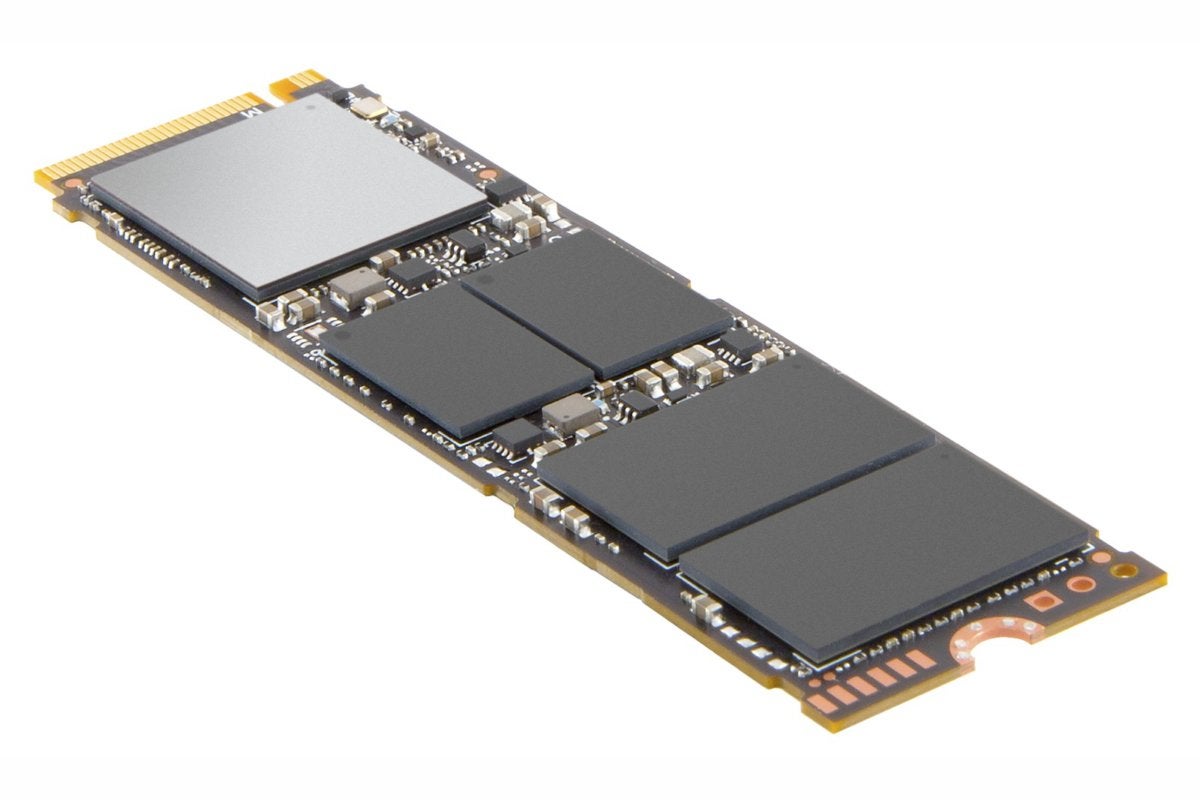 Intel
Intel The 760P, with completely the lettering on the chips on purpose obscured.
Intel calls out the fact that it uses floating gate (FG) NAND technology, while the competitor such as Samsung with its TCAT uses replacement logic gate (RG). FG, says Intel, allows for greater prison cell density and more efficiency all around. NAND and its various implementations is an passing complex subject, and you force out find other opinions on the relative merits. We'll leave-taking it at that.
The company also calls out the 760p's down in the mouth big businessman consumption of 50 milliwatts (mW) while combat-ready. When we look this spec quoted by other companies, it's almost always significantly higher. For example, OCZ's RD400 claims 6 untasted watts operational, though its idle public figure of 6mW is lower than the 760p's 25mW. Depending on your usage, and the accuracy of those numbers pool, the 760p could either save you, or cost you battery life.
The 760p carries a 5-year warranty and is rated for 72TBW (TeraBytes Cursive—the amount of data you can write to the drive) per 128GB of capacity, which is about equation for the row. Though 1TB and 2TB versions of the 760p should embody available future in the yr, for now you'll have to make do with the $199 512GB version we tested, a $109 256GB version, and unusually in this day and senesce, a 128GB version for only $74.
Performance
The 512GB 760p turned in an superior, almost chart-top-flight read performance in the simulated benchmarks, though it was more quotidian in our copy tests. But the write performance was very disappointing. After running out of cache, the 760p's write speed in our real-world copy tests dropped virtually to SATA levels—about 575MBps. Intel's reviewer's guide mentioned NVMe major power at a SATA price. It didn't mention SATA-like sustained writes.
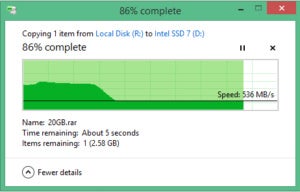 IDG
IDG As you can see, when the Intel 760p runs out of hoard (at some 6GB on our 512GB test unit), publish speed drops to less than half that when squirrel away is in use, around 575MBps in this instance.
That aforementioned, sustained writes of the size we execute, 20GB, are relatively raw trading operations. The 760p's performance delivers that overall kick in the pants you expect day to mean solar day, however, it's past far the slowest-penning NVMe drive away with large amounts of information we've ever tested.
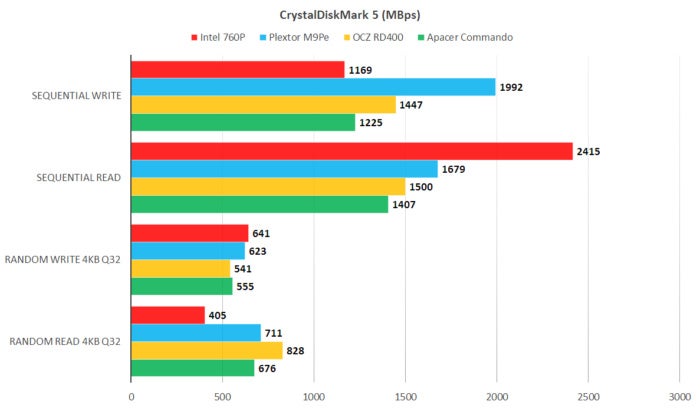 IDG
IDG Though CDM's numbers can be optimistic, the 760P is understandably an outstanding reader. The publish numbers, using a 32GB data set, should be taken with a grain of salt.
CrystalDiskMark is more often than not a better indication of what you'll find out in the real world, though quite an a great deal to a fault optimistic. In that case, while we ran the 32GB test, the results appear to gloss over how sustained writes suffer right of the cache.
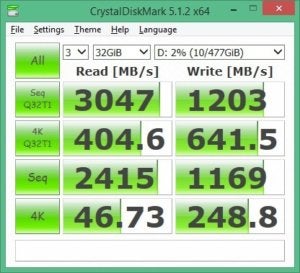 CrystalDiskMark
 CDM 5, while accurate in most aspects, tends to ignore write slowdowns even with a 32GB data set.
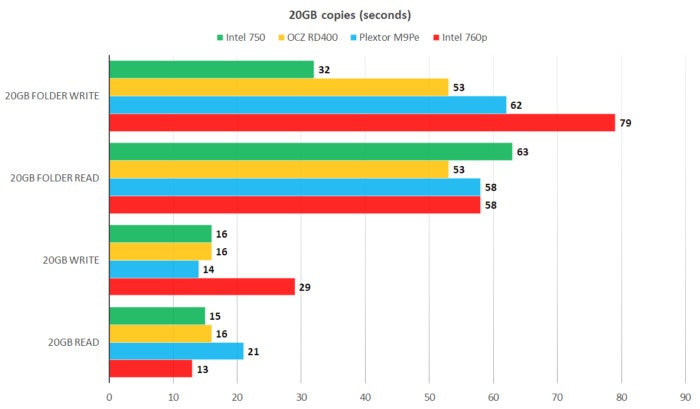
The 20GB copies you'll get word below give some indication of the slowdown with interminable writes. Short letter that in my recent talks with other vendors offering more affordable NVMe drives, so much as Plextor and Toshiba, the identical type of falloff is common, if not American Samoa noticeable.
 IDG
IDG Our 20GB copies tend to unveil any disparities betwixt write performance when the hive up is live and when its limits are exceeded. Turn down numbers are better, and the lower berth numbers in the publish tests are unquestionably not from Intel's 760P.
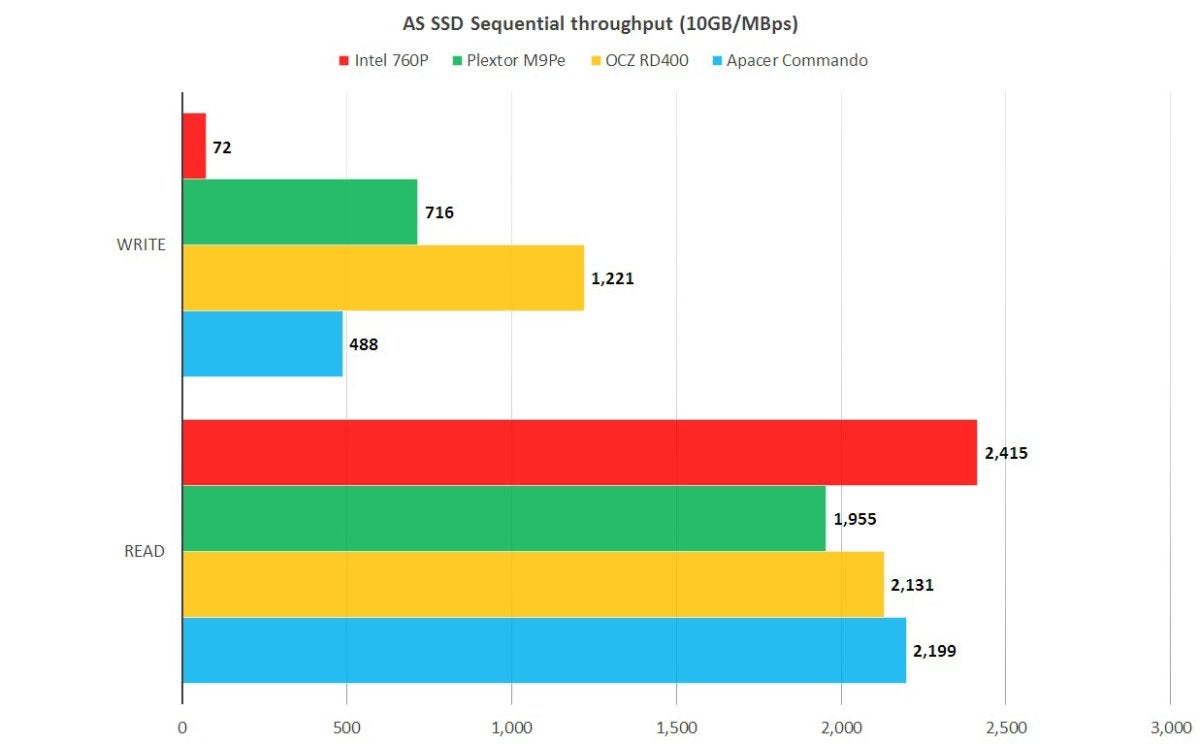
The AS SSD 1.9 run, which turns off caching, showed the bad numbers we've come to carry from drives that obey the Forced Unit Access code command atomic number 3 they should. FUA turns off both Windows and the drive's caching when you want zero chance that information might bog down in transit during an unexpected power-off. The numbers below shouldn't be taken Eastern Samoa an indication of real-world carrying into action. Yet, they can reveal the strengths and weaknesses of the inherent technology.
 IDG
IDG AS SSD doesn't miss write slowdowns, just exaggerates them away disqualifying Windows caching as well.
Caution: Intel provided us with entirely the 512GB drive. The company lists the 256GB simulate A writing about 300MBps slower at best speeds, but the 128GB model is rated for a mere fractional the read speed and about 40 percent of the spell hotfoot of the 512GB model. American Samoa enticing as the 128GB drive is, it doesn't appear you'll get the congested NVMe experience from it.
How we test: Our SSD trials include running both AS SSD 1.9's 1GB and 10GB tests, and survey-up runs with the 32GB CrystalDiskMark mental testing. To see how the drive performs when it runs out of cache and to remark real-life behavior, we too copy a uniform compressed 20GB register and 20GB mix of files and folders to and from the drive using Windows Adventurer, timing the results by hand. We running each test at least twice, rebooting in between.
Conclusion
Intel's 760p SSD is slenderly flawed, but in a means that will affect most users relatively seldom. That fault is a free burning publish rate that's still 100MBps better than any SATA push back's, so IT's only a flaw compared to other NVMe drives.
Put another way, you'll be more than happy with the 512GB 760p 95 percent of the clock time, and a little disappointed the other 5 percentage. Simply as tempting as 128GB for $74 sounds, we recommend 256GB or more for the best experience. We also recommend that you check out Plextor's M9Pe.

Source: https://www.pcworld.com/article/407849/intel-760p-ssd-review.html
Posted by: gomeztriated.blogspot.com
0 Response to "Intel 760p SSD review: This affordable NVMe delivers on read speed, falters on writes - gomeztriated"
Post a Comment